

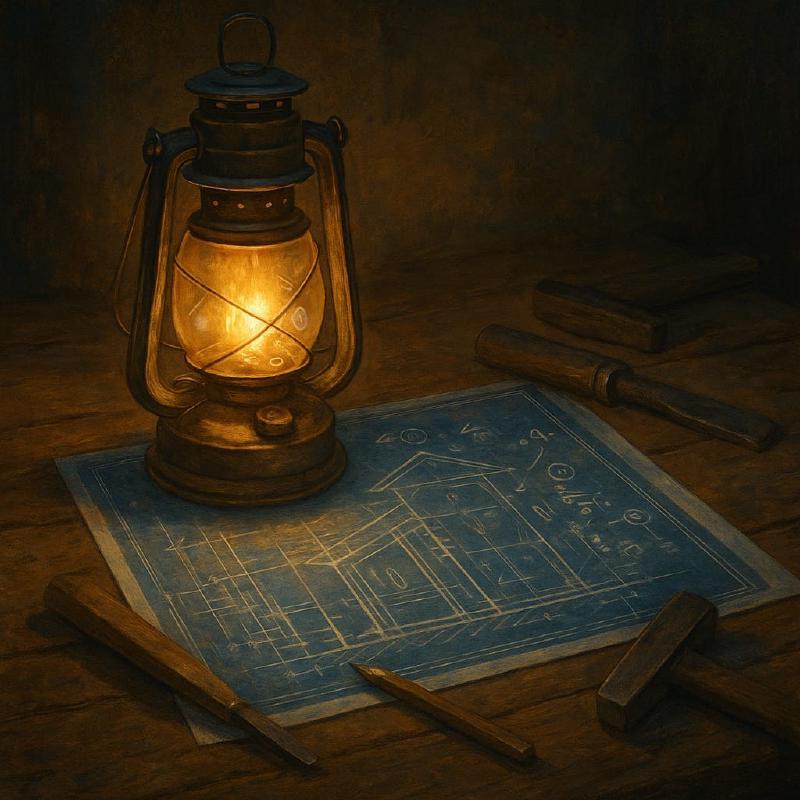
The lantern illuminates a blueprint.
For information: ChatGPT generated the bulk of this post as a result of a long conversation we had together. We shared ideas, we exchanged research results, and we learned from each other. It is my goal to inspire you and make you think for yourself.
In a city that was always half-built and half-rebuilt, the Builders met every season in a long hall of wood and glass. They came with ink-stained fingers and rough hands, with soot on their sleeves and new ideas in their pockets. They argued a lot, but not because they wanted to win. They argued because the city depended on it.
This season, a new tool had arrived in the marketplace: a lantern that could sketch a structure before the first stone was lifted. You spoke a few wishes into it — how tall, how strong, how fast — and in its warm light showed beams, joints, and plans. Some Builders adopted it instantly. Others crossed their arms and watched.
The Hall filled with the old, familiar tension: Is this the next step up, or the first step down?
The First Lantern: Writing#
An elder Builder stood and told a story older than any of them.
“Once,” she said, “people carried every plan in memory. A master would teach a student by firelight, and the student would learn by repeating each blueprint until it lived inside their skull.”
Then someone invented marks on clay—a way to store plans outside the mind.
“There were fears,” she said. “That memory would wither. That wisdom would become imitation. That people would only seem to know.” The old fears were written down, too — ironically, on the very medium they distrusted.
“But the city grew taller. Plans travelled farther than any teacher. Knowledge no longer died with the knower. People forgot some things, yes. And in exchange, they learned to hold bigger thoughts.”
The Hall was quiet. Everyone knew the trade: letting go of the small so you could carry the large.
The Flood of Pages: The Printing Press#
A younger Builder leaned forward. “I’ve read about the age when plans became cheap.”
She meant the press that could stamp a thousand pages in the time it took one scribe to finish a paragraph.
“People panicked then, too,” she said. “Too many books. Too much bad knowledge. Apprentices are reading nonsense instead of learning the trade. Authority cracking. Confusion everywhere.”
“And yet,” she went on, “literacy spread, science accelerated, and when the flood arrived, we built boats: editors, libraries, schools, catalogues. The press didn’t end our understanding. It made us invent better ways to choose what to trust.”
The scribes faded. The city didn’t.
The Looms and the Hammering: The Machines#
A Builder with threadbare gloves spoke next.
“There was a time,” he said, “when cloth was a masterpiece made by hands that knew every fibre. Then looms arrived that could do in hours what used to take a week.”
The craftsmen who lived by that skill raged. Not because they hated tools, but because they feared being made unnecessary and feared that quality would collapse with speed. They broke the machines and were remembered as enemies of progress.
“But the cloth became affordable for all. And new crafts emerged. There was pain along the way — real pain, real displacement — but the net result was a city whose people could live warmer, longer lives.”
“Speed always scares the people who built their lives around slowness,” he said gently. “And sometimes the fear is justified. But once a tool multiplies what humans can do, history rarely chooses to go backwards.”
The Pocket Calculators#
From the back bench came a laugh.
“When I was an apprentice,” said another, “they told us the little pocket calculators would rot our brains. ‘You won’t know arithmetic anymore,’ they said. ‘You’ll be helpless without it.’”
The warnings weren’t silly. Students who relied on calculators before learning fundamentals struggled. But in shops and schools that taught both number sense and tool use, something else happened: time shifted from mechanical arithmetic to modelling, reasoning, and solving real problems.
“The tool did not decide the outcome,” the Builder said. “Teaching did.”
Heads nodded. That one felt close to home.
The Red Underlines: Spell-Check#
Another Builder tapped the table with a pencil.
“Even the red underlines were accused of making us sloppy. People said writing would decay into laziness. And yes — some trusted the machine too much and got burned.”
“But overall, mistakes fell, speed rose, and we learned a new rule: the tool is an assistant, not an author. The judgment stays with you.”
The Voices Through Wire: The Telephone#
A Builder who travelled often told the story of the talking wires.
“They said it would ruin conversation. Make people rude. Replace thoughtful letters with half-formed chatter. The etiquette didn’t exist yet, so early calls sounded like chaos.”
“And then we wrote etiquette. Greetings, privacy norms, schedules, and emergency protocols. The wires weren’t the problem. We just hadn’t learned how to live with them.”
The Great Net#
Finally, someone mentioned the Great Net that spanned the world.
It made any plan findable, any idea borrowable, and any library reachable. And once again, the fear returned, wearing new clothes: shallow skimming, weakened attention, the end of deep thought, the end of expertise.
The city did gain new troubles. Distraction thrived. Misinformation travelled at the speed of a click. But the Great Net also created a massive leap in learning and coordination. The lesson was not “tools don’t affect minds.” It was “tools change us, and we can shape the change.”
The Ladder and the Machine Room (Compilers and Assembly)#
When all the lantern stories had been told, a Builder stood by the window, looking out at the machines that powered the city.
“Under every street,” he said, “there is a machine room. Gears and belts and pistons. A Builder who never learns how it works will eventually design a bridge that sings in the wind and collapses.”
Everyone understood: CPU, IO, memory — these were the machine room.
“But does every Builder need to forge every gear by hand?” he asked.
No one answered right away.
“You can understand the machine room without living there,” he said. “You can learn the physics of load without smelting your own steel. You can reason about performance without writing assembly.”
He walked to the ladder leaning against the wall.
“Once, we climbed from bare metal to higher languages. Compilers were a rung. IDEs were a rung (a horizontal step on a ladder). Libraries were a rung. Each rung removed some labour and raised what we could attempt. We stopped memorising the shape of every bolt and started designing whole neighbourhoods.”
“Some Builders still go down into assembly,” he added. “They’re precious: the ones who tune the engines, who build the compilers, who solve the hardest constraints. The city needs them. But the city does not need everyone to live there.”
The ladder was not a betrayal of the machine room. It was a way to reach the roof.
The Shape of Every Panic#
A pattern emerged in the Hall, as clear as a blueprint:
- A tool arrives that automates a hard or boring task.
- People worry that their minds and skills will weaken.
- Some misuse proves the fear possible.
- Gains are too strong to ignore; adoption spreads.
- Skills shift upward; norms and teaching adapt.
- Life gets more productive — often better — though not without tradeoffs.
The city had lived this cycle again and again.
What the New Lantern Really Demands#
By the end of the meeting, no one was shouting. They were drafting rules.
Because the truth was this:
A lantern that sketches structures does not remove responsibility. It moves it.
It can lift the floor — fewer typos, less boilerplate, faster scaffolding. It can also become a crutch — if a Builder stops understanding what holds a building up.
So the Hall etched new norms into the wood:
- Learn the machine room.
- Use the ladder.
- Treat lantern plans as drafts, not truth.
- Verify with tests, review, profiling, and reason.
- Keep a path open for deep specialists.
The lantern was neither saviour nor saboteur. It was a rung.
And the city, as always, would decide whether to climb thoughtfully — or not at all.
Additional reading#
When thinking and talking about this subject, I was thinking about the book by Jamie Dobson.
Visionaries, Rebels and Machines: The story of humanity’s extraordinary journey from electrification to cloudification
https://www.amazon.com/dp/1915483158
If you prefer a video, I really like the Keynote by Dr Werner Vogels at Re: Invent 2025. He introduced me to Renaissance Developer.
AWS re:Invent 2025 - Keynote with Dr. Werner Vogels